



Quick Answer: Working line German Shepherds are bred for performance — straighter backs, higher drive, and a strong fit for police, military, and dog sport work. Show line German Shepherds are bred for conformation — a sloped topline, a calmer temperament, and a strong fit for family life and the show ring. Neither line is “better.” The right choice depends on your experience level, your activity level, and what you actually want your dog to do.
Last Updated: [26 June 2026] · Written by Abhiram · Temperament & training sections reviewed by Abhinav Rao (Dog Trainer since 2011) · Health section reviewed by Dr. R. Divya Sharma, DVM
If you’ve started researching German Shepherds, you’ve probably run into a confusing split: some breeders talk about “working lines,” others about “show lines,” and plenty of forum threads argue heatedly about which one is the “real” German Shepherd. It’s not just internet noise. Choosing the wrong line for your lifestyle is one of the most common, and most preventable, reasons German Shepherds end up surrendered to shelters and rescues.
This guide breaks down exactly what separates a working line German Shepherd from a show line German Shepherd — structure, temperament, health, price, and real-world suitability — so you can make a confident decision instead of a guess.
Working Line vs. Show Line at a Glance
| Trait | Working Line | Show Line |
|---|---|---|
| Bred primarily for | Performance, drive, function | Conformation, breed-standard appearance |
| Topline (back) | Level, straight | Sloped (“roached”), angulated hindquarters |
| Gait | Efficient, ground-covering trot | Pronounced “flying trot” |
| Coat colors | Sable, black, bi-color (most common) | Black & tan, black & red, saddle/blanket patterns |
| Energy level | Very high | Moderate to high |
| Drive/intensity | High prey and defense drive | Moderate, more biddable |
| Trainability | High, but needs an experienced handler | High, generally easier for novices |
| Common roles | Police, military, search & rescue, Schutzhund/IGP sport | Conformation shows, family companionship, moderate sport work |
| Health testing priority | Critical regardless of line | Critical regardless of line |
| Typical price (pet-quality puppy) | $1,500–$4,000+ | $800–$2,500 |
| Best suited for | Active owners, handlers, working homes | Families, first-time owners, companion homes |
What Is a Working Line German Shepherd?
A working line German Shepherd is bred first for ability and only second for appearance. Breeders select for nerve strength, prey drive, focus, and physical stamina, with the goal of producing a dog that can genuinely perform a job, not just look the part. These dogs trace their development to the original purpose of the breed: herding and guarding livestock in late-1800s Germany, a job that demanded endurance and a stable, level back over a showy gait.
Within “working line,” there are three recognized sub-types, and they aren’t interchangeable.
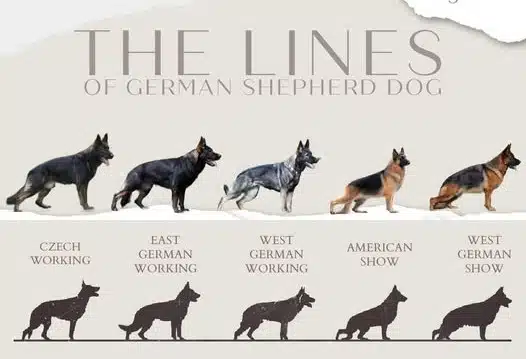
East German (DDR) Working Line
Bred behind the Iron Curtain under strict state-controlled breeding programs, DDR-line dogs are known for heavy bone, a calmer working temperament than other working lines, and a reputation for resilience. Many modern working-line pedigrees trace back to DDR breeding stock.
West German Working Line
Bred to the SV (Verein für Deutsche Schäferhunde, the breed’s German parent club) working standard, these dogs balance drive with trainability and are common in sport (Schutzhund/IGP) and service roles.
Czech Working Line
Originally developed for the Czechoslovak border patrol, Czech-line dogs are typically leaner and even higher-drive than DDR or West German working lines, often considered the most intense of the three.
What Is a Show Line German Shepherd?
A show line German Shepherd is bred primarily to meet a kennel club’s conformation standard: physical structure, movement, and breed type as judged in the show ring. As dog shows grew in popularity through the 20th century, breeders pursuing ring success gradually diverged from the working-dog breeders, eventually producing the distinct look most people now associate with “classic” German Shepherds.
American Show Line
Bred to the AKC standard. This is the line with the most pronounced sloped topline and dramatic “flying trot,” prioritizing visual movement in the ring.
West German Show Line
Bred to the SV/FCI standard, which is notably stricter about health testing and working temperament than the AKC standard. West German show lines tend to have a more moderate topline than their American counterparts and often retain usable working ability.
Canadian Show Line
Bred to standards similar to the AKC, Canadian show lines are closely related to American show lines in both appearance and temperament.
Physical & Structural Differences
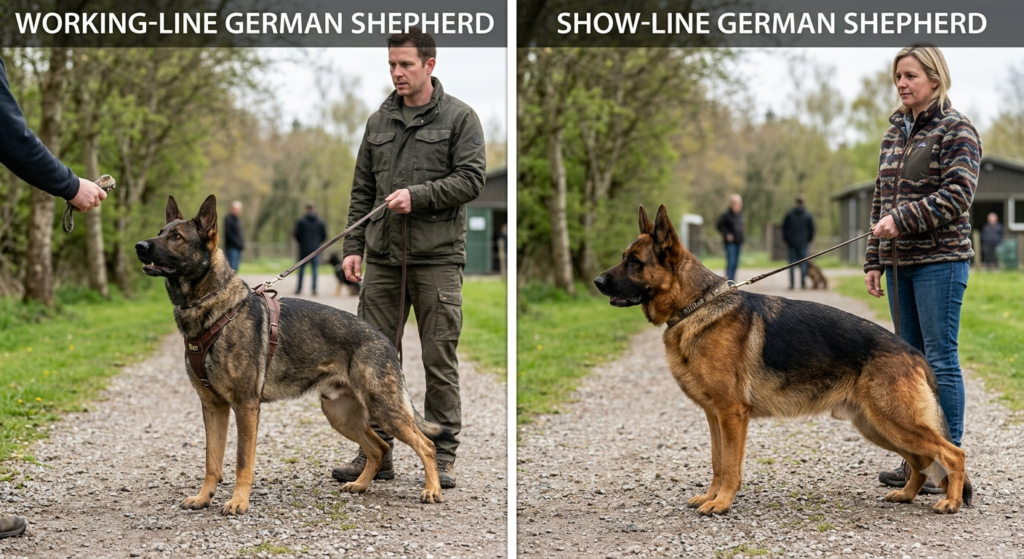
The most visible difference between the two lines is the topline. Working line German Shepherds carry a level, straight back built for sustained, efficient movement — useful for a dog that needs to cover ground all day without injury. Show line German Shepherds carry a sloped, “roached” topline with more angulated rear legs, a structure selected for a specific visual movement pattern in the show ring rather than for working stamina.
This structural difference shows up clearly in gait. Working lines move with an efficient, low-effort trot designed for endurance. Show lines move with the breed’s signature “flying trot,” a more dramatic, ground-covering stride that scores well in conformation judging but is debated among working-dog people as less functional for actual labor.
Coat color also tends to differ, though it’s a looser rule than structure. Working lines are frequently sable, solid black, or bi-color. Show lines are more often seen in the classic black-and-tan or black-and-red saddle and blanket patterns that most people picture when they hear “German Shepherd.”
Temperament & Drive: Which One Has More Energy?
Reviewed by Abhinav Rao, Dog Trainer (since 2011)
Working line German Shepherds run hot. They carry high prey drive, high defense drive, and the kind of nerve strength that lets them stay focused under pressure most family dogs would find overwhelming. That same intensity means they need a job, structured daily outlets, and an owner who can match their drive with consistent training — without that, the same traits that make them excellent working dogs can turn into destructive or frustrated behavior at home.
Show line German Shepherds are generally calmer and more biddable, without losing the breed’s underlying intelligence or loyalty. They still need real exercise and mental stimulation, but their lower-intensity drive makes them far more forgiving of an inexperienced or first-time handler’s mistakes.
To understand the practical difference between these lines, consider Jax, a Czech working-line sable, and Enzo, a West German show-line black-and-tan. During training, the sight of a decoy triggers a laser-focused, high-intensity drive in Jax; he views work as a biological necessity and requires a high-level job (like IGP or nosework) to prevent him from inventing destructive outlets at home. Conversely, Enzo looks at the same decoy with mild curiosity before easily being redirected by a food reward.
As mirrored in the physical comparison in the above image, Enzo’s lower-ceiling drive and standard “off-switch” make him perfectly content to settle at your feet after a standard hike, whereas Jax’s straight-backed, high-threshold engine will spend the evening demanding a task, illustrating why working lines suit intensive sports while show lines excel as active family companions.
Health Differences: Is One Line Actually Healthier?
Reviewed by Dr. R. Divya Sharma, DVM
This is one of the most repeated claims in German Shepherd circles, and it deserves more nuance than most articles give it. You’ll frequently see it stated as flat fact that working lines are healthier than show lines, usually pointing to hip and elbow dysplasia rates and the show line’s more angulated rear structure. There’s a plausible biomechanical argument behind that claim, but the veterinary and breeding community is genuinely divided on how much of the difference is caused by structure versus how much is simply explained by which breeders, in either line, actually do rigorous health testing.
What’s not in dispute: hip and elbow dysplasia occur in both lines, and the single biggest predictor of a healthy adult dog isn’t “working line” or “show line,” it’s whether the parents were OFA- or SV-hip-and-elbow-certified before breeding. The German Shepherd Dog Club of America (GSDCA) and the breed’s German parent club (SV) both require or strongly recommend formal hip and elbow scoring for breeding stock, and reputable breeders in both lines test for it. A working-line puppy from an untested pairing carries real dysplasia risk too.
Beyond joints, both lines share breed-wide predispositions worth knowing about, including degenerative myelopathy and bloat (gastric dilatation-volvulus). Ask any breeder, regardless of line, for documented health clearances on both parents — not just a verbal assurance.
Which Is Better for Families or First-Time Owners?
Choose a working line German Shepherd if:
- You have prior experience handling high-drive dogs
- You can commit to daily structured training and real physical/mental outlets
- You want a dog for sport (Schutzhund/IGP), protection work, or an active working role
- You have the time, fencing, and lifestyle to match an intense dog
Choose a show line German Shepherd if:
- This is your first German Shepherd, or your first high-energy breed
- You want a loyal, intelligent companion without needing a “job” to keep them stable
- You have a family with children and want a more forgiving, even-tempered dog
- You still want a dog capable of basic protective instincts and obedience/agility work
Real-World Roles: Police, Military, Sport, and Companion Work
Working line German Shepherds dominate professional and competitive roles: police K9 units, military working dogs, search and rescue, and Schutzhund/IGP sport. Their drive, focus, and resilience under stress are exactly what these roles require, and it’s part of why the breed has held a place in law enforcement and the military for over a century.
Show line German Shepherds are far less common in those high-intensity roles, but they’re not “just” pets. Many compete successfully in conformation, and plenty also do well in obedience, agility, and moderate protection or nose-work training. Their core job, though, is usually companionship — and they’re very good at it.
Price Differences: How Much Does Each Line Cost?
Pricing varies by breeder, region, and pedigree, but as a general guide:
- Working line puppies typically run $1,500–$4,000+, with dogs from proven sport or import lines (especially Czech or DDR pedigrees with documented titles) commanding the higher end.
- Show line puppies typically run $800–$2,500, with show-quality or top-pedigree dogs from titled parents priced higher than pet-quality littermates.
Health testing, hip/elbow certification, and documented working or show titles in the parents are the biggest price drivers in either line — not the line itself. For a fuller breakdown of what drives German Shepherd pricing overall, see our German Shepherd Price Guide.
Common Myths About Working Line vs. Show Line GSDs
Myth: “Show line German Shepherds can’t work or protect.” False. Show line dogs, especially West German show lines, often retain solid working ability and protective instinct — they’re simply less intense about it than a working-line dog bred specifically for that purpose.
Myth: “Working line German Shepherds are always aggressive.” False, and an important distinction: drive is not aggression. A well-bred, well-trained working line dog is confident and focused, not unpredictably aggressive. Poor breeding or poor training, not the line itself, produces unstable temperaments.
Myth: “Working lines are always healthier than show lines.” Overstated. As covered above, health testing practices matter far more than line alone. A tested show line dog can easily be healthier than an untested working line dog.
Myth: “There’s a single, official ‘working line’ and ‘show line’ standard.” Not quite. These are breeding-community classifications, not formal categories recognized identically by every kennel club. The FCI (the breed’s international governing body, via the German SV) and the AKC apply different emphases, which is part of why American show lines look notably different from West German show lines.
How to Tell Which Line a Puppy Comes From
Don’t rely on a puppy’s looks alone, especially at 8 weeks old. Instead:
- Ask for the full pedigree, going back at least 3–4 generations.
- Look up the titles behind each parent’s name. Working titles (like IGP1/2/3, formerly Schutzhund, or herding titles) indicate working line breeding. Show titles (like CH, GCH, or VA in SV pedigrees) indicate show line breeding.
- Check the registering body. AKC-only pedigrees skew toward American show lines; SV/FCI pedigrees are more likely to include German working or West German show lines.
- Ask the breeder directly which line(s) they breed for and why. A reputable breeder will explain their breeding goals clearly, not dodge the question.
Frequently Asked Questions
Can a show line German Shepherd still do protection work? Yes. Many show line German Shepherds, particularly West German show lines, retain real protective instinct and can be trained for personal protection or sport. They typically require less management of intensity than a working line dog doing the same training.
Are working line German Shepherds good family dogs? They can be, but only in homes that can meet their exercise, training, and mental-stimulation needs. Without consistent structure and a real outlet for their drive, working line dogs are more prone to developing anxious or destructive behaviors than show line dogs in the same situation.
What’s the difference between East German (DDR) and West German working lines? DDR-line dogs tend to be heavier-boned with a somewhat calmer working temperament, a legacy of state-controlled East German breeding programs. West German working lines balance drive with trainability and are more common in modern sport and service roles.
Do working line German Shepherds really have fewer health problems than show lines? Not reliably. Hip and elbow dysplasia occur in both lines. The strongest predictor of a healthy puppy is documented OFA or SV health testing on both parents, regardless of which line they come from.
Which line is better for a first-time German Shepherd owner? Show line dogs are generally the safer choice for first-time owners due to their more moderate energy and drive. A working line dog can still work for a first-time owner who is genuinely prepared to commit to daily structured training, but it’s a harder path.
Can you mix working line and show line German Shepherds? Yes, and many breeders do, aiming for a dog with moderate drive and sound structure. Offspring from such pairings can vary widely in temperament and structure, so ask the breeder about both parents’ lines and titles rather than assuming a predictable “middle ground” result.
About This Guide
Written by: Abhiram, pet parent and writer Temperament & training content reviewed by: Abhinav Rao, Dog Trainer (since 2011) Health content reviewed by: Dr. R. Divya Sharma, DVM (Veterinary Consultant) Last updated: [26 June 2026]
Sources & further reading:
- American Kennel Club (AKC) — German Shepherd Dog Breed Standard
- Fédération Cynologique Internationale (FCI) — Standard No. 166, German Shepherd Dog
- German Shepherd Dog Club of America (GSDCA) — breed health resources
- Orthopedic Foundation for Animals (OFA) — hip and elbow dysplasia statistics
Related reading on this site:
