



Quick Answer: Most spider bites on dogs cause minor redness, swelling, or itching — similar to a mosquito bite — and heal on their own within 2–3 weeks. Two species in North America (black widow and brown recluse) can cause serious or life-threatening reactions and need emergency vet care. If your dog shows muscle spasms, vomiting, difficulty breathing, or a rapidly spreading wound, go to a vet immediately.
Last Updated: [23-july-2027] · Written by Abhiram · Health content reviewed by Dr. R. Divya Sharma, DVM
You notice your dog gnawing at a spot on their leg. You part the fur, see a small red welt, and immediately start wondering: was that a spider? Which one? Is it dangerous? Do we need to drive to the emergency vet right now, or can this wait until morning?
Table of Contents
This guide answers all of it — how to identify a spider bite on your dog, what each dangerous species’ bite actually looks like, exactly what to do in the first 30 minutes, and the one decision that matters most: home care or emergency vet, right now.
What Does a Spider Bite Look Like on a Dog?
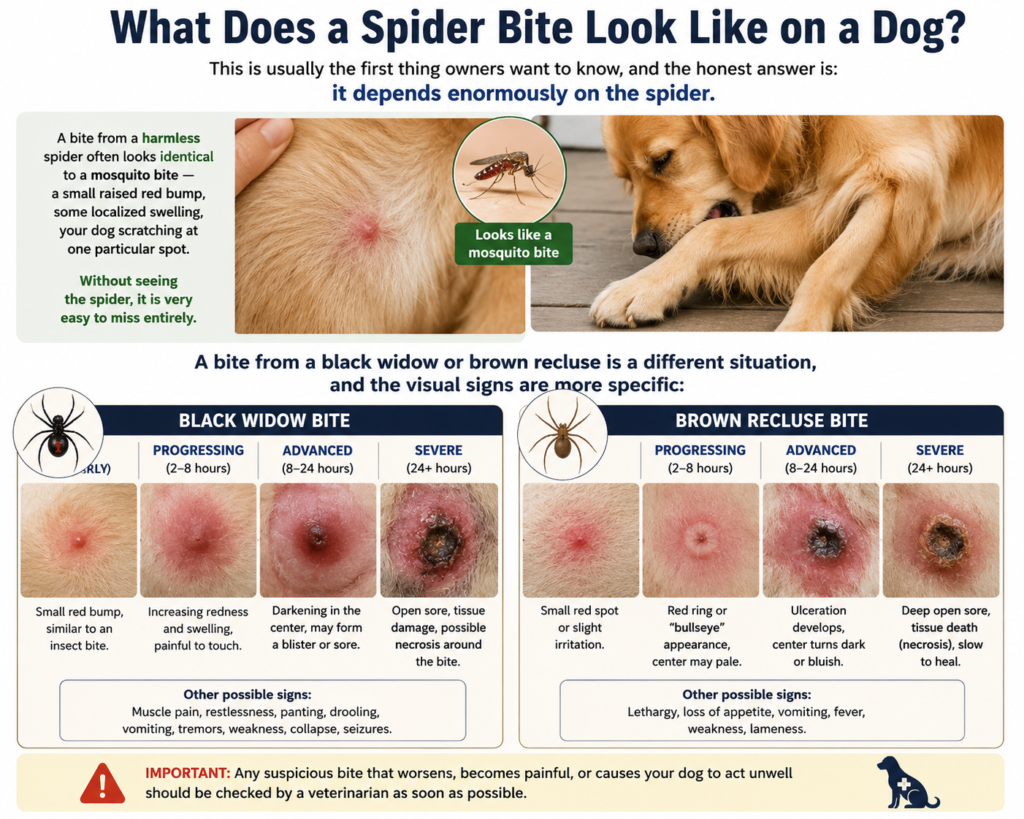
This is usually the first thing owners want to know, and the honest answer is: it depends enormously on the spider.
A bite from a harmless spider often looks identical to a mosquito bite — a small raised red bump, some localized swelling, your dog scratching at one particular spot. Without seeing the spider, it is very easy to miss entirely.
A bite from a black widow or brown recluse is a different situation, and the visual signs are more specific:
| What You See | Likely Type | What to Do |
|---|---|---|
| Small red bump, mild swelling, dog scratching one spot | Non-venomous spider (most species) | Home care, monitor closely |
| Painful redness and swelling, no visible wound center | Possible black widow | Call vet within the hour |
| Red mark → white blister → bull’s-eye → dark or dead tissue | Brown recluse | Emergency vet — now |
| Raised welt with a small puncture mark at the center | Unknown spider | Monitor closely, call vet |
Where to look: Spiders bite wherever their fangs reach skin — on a dog, that is most often the nose, face, paws, and belly, the areas they use to investigate things. Part the fur carefully and systematically. On thick-coated breeds like German Shepherds, bites are easy to miss. Pay extra attention to the belly and inner legs, where the coat is thinner and skin contact with the ground is more direct.
Symptoms of a Spider Bite on a Dog
Mild Symptoms (Non-Venomous Bites)
Most spider encounters produce only mild, local reactions:
- Localized redness and swelling at the bite site
- Itching — your dog scratches, licks, or chews the same spot repeatedly
- Mild tenderness if you press the area
- A small raised bump, often similar in appearance to a mosquito bite
- Restlessness or mild agitation
These symptoms are uncomfortable but not dangerous. They typically resolve within a few days to two weeks with basic home care.
Severe Symptoms — Go to the Vet Immediately
Reviewed by Dr. R. Divya Sharma, DVM
The following symptoms indicate a venomous bite or a significant allergic reaction. Do not wait to see if they improve on their own:
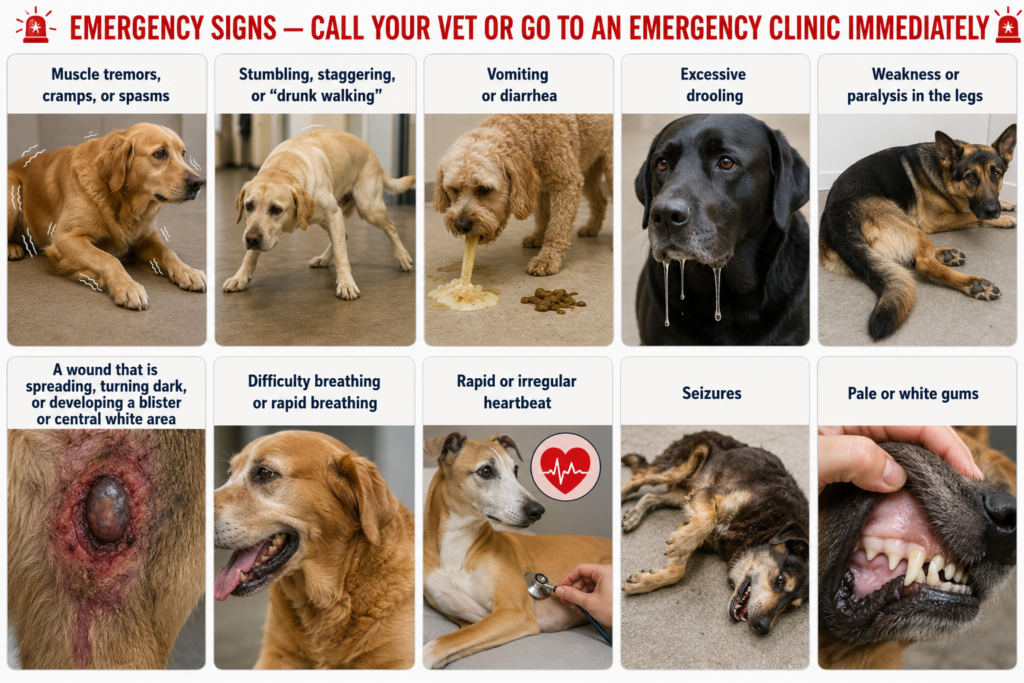
Emergency signs — call your vet or go to an emergency clinic immediately if you see any of these:
- Muscle tremors, cramps, or spasms
- Stumbling, staggering, or “drunk walking”
- Vomiting or diarrhea
- Excessive drooling
- Weakness or paralysis in the legs
- A wound that is spreading, turning dark, or developing a blister or central white area
- Difficulty breathing or rapid breathing
- Rapid or irregular heartbeat
- Seizures
- Pale or white gums
Symptoms from a black widow bite can appear within 30 to 60 minutes. Brown recluse symptoms often take hours or even days to develop, which is why monitoring a suspected bite closely over 24 to 48 hours is essential even when your dog seems completely fine at first.
Which Spiders Are Dangerous to Dogs?
Black Widow Spider Bite on Dogs
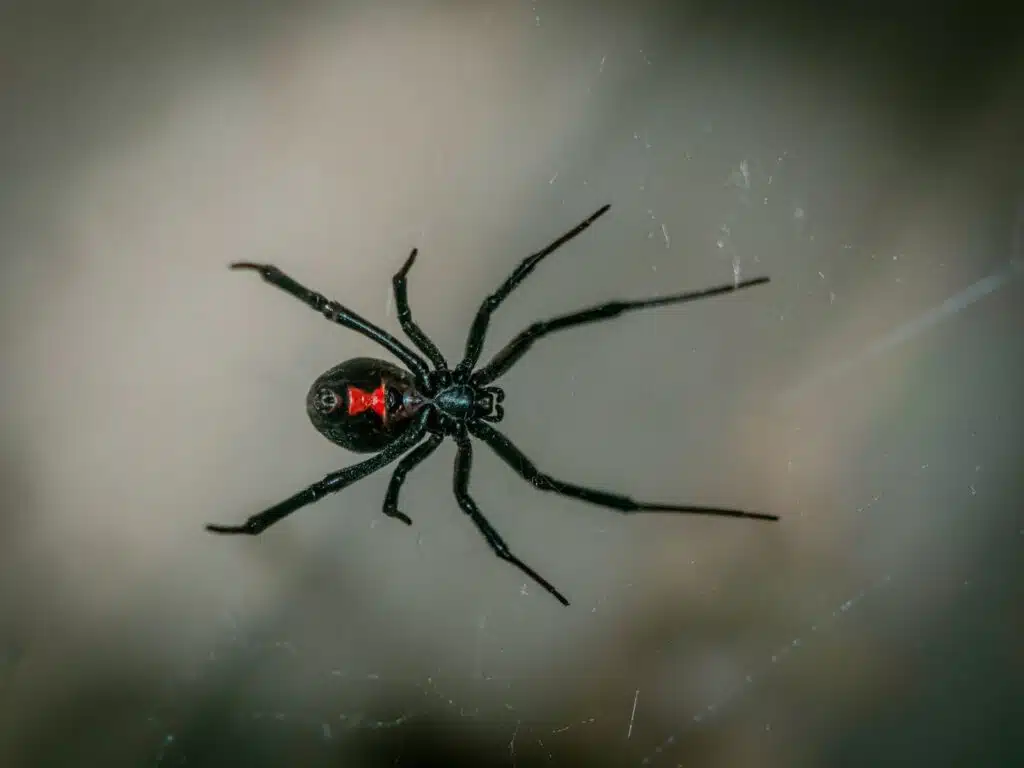
How to identify the spider: Black widows are glossy black with a distinctive red hourglass shape on the underside of the abdomen. They prefer warm, dark, sheltered spaces — woodpiles, sheds, under garden furniture, and inside garages and outbuildings.
Why it is dangerous: Black widow venom contains alpha-latrotoxin, a powerful neurotoxin that attacks the nervous system. The bite itself often causes no visible wound and may not even be immediately painful — which is exactly what makes it so dangerous. By the time symptoms appear, the venom is already circulating in your dog’s system.
What to expect: Neurological symptoms typically develop within 30 minutes to a few hours of the bite. These include muscle pain and spasms, difficulty walking, tremors, drooling, and vomiting. In severe cases, particularly in smaller dogs, a black widow bite can be fatal without treatment.
Treatment: Antivenom for black widow bites is available and highly effective — your vet can administer it intravenously, and symptoms typically begin to resolve within 30 minutes of treatment. Supportive care including IV fluids, pain medication, and muscle relaxants are also used. With prompt treatment, the prognosis is good.
Brown Recluse Spider Bite on Dogs
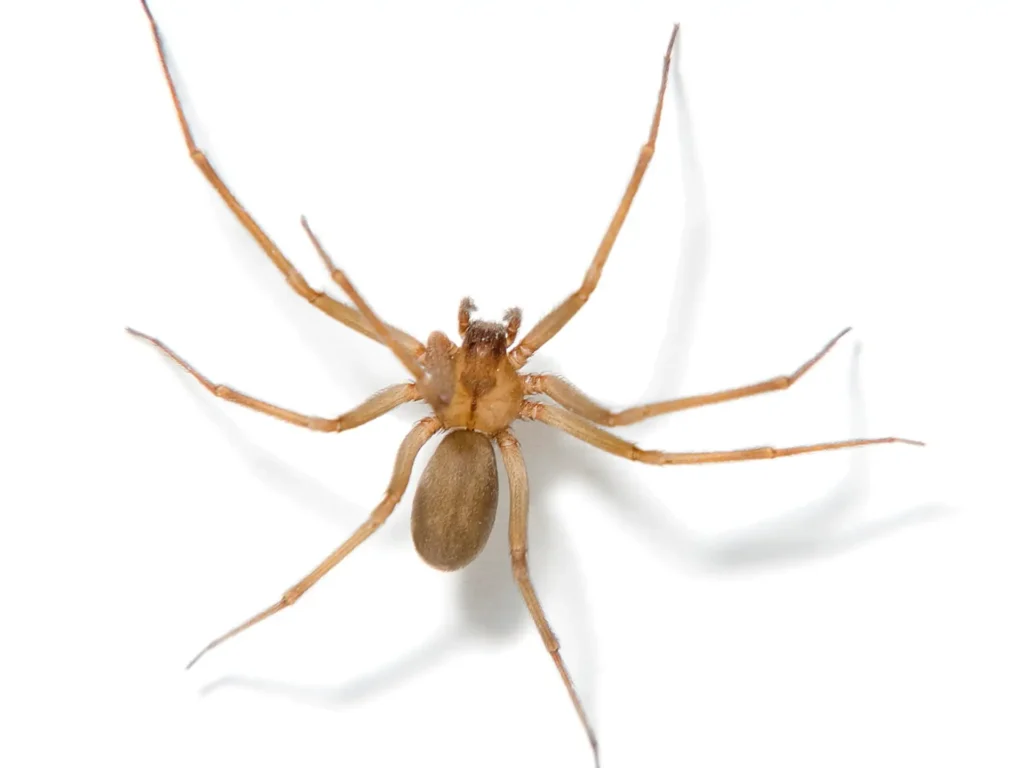
How to identify the spider: Brown recluses are light to dark brown with a violin-shaped marking on the upper body. Unlike most spiders, they have six eyes arranged in three pairs rather than eight. They live in quiet, undisturbed places — closets, cardboard boxes, attics, basements, and beneath rarely-moved furniture.
Why it is dangerous: Brown recluse venom is hemotoxic, meaning it destroys tissue at and around the bite site. The initial bite is typically painless — a real problem, because by the time your dog shows visible distress, significant tissue damage may already be well underway.
What to expect — the bite progression:
- Hours 1–8: No pain or minimal discomfort. A small red mark appears.
- Days 1–3: A white blister or raised area develops. A classic bull’s-eye pattern may form — a dark center, a pale ring, then an outer ring of redness.
- Days 3–7: The central tissue begins to die (necrosis) and turns dark. The surrounding area may swell significantly.
- Week 2 onwards: Dead tissue may slough off, leaving an open ulcer that heals very slowly.
- Severe cases: Systemic signs including fever, lethargy, anemia, and kidney involvement can develop.
Treatment: There is currently no antivenom for brown recluse spider bites in the United States. Treatment is entirely supportive — thorough wound cleaning, cold compresses, bandaging, antibiotics to prevent secondary infection, and pain medication. In severe cases, surgical removal of dead tissue (debridement) may be required, and skin grafting is sometimes necessary. Your vet will want to see your dog on a weekly basis until the wound is fully healed.
Healing time: Minor bites may heal in 1–8 weeks. Severe necrotic wounds can take 3 to 8 months to fully resolve, and permanent scarring is possible in some cases.
Other Spiders in North America That May Bite Dogs
Yellow sac spiders are among the most common household spiders in North America and are capable of biting dogs when disturbed. Their bites cause localized redness and mild pain but are rarely medically serious. Treat the same as any non-venomous bite.
Hobo spiders (found primarily in the Pacific Northwest) have been associated with bite symptoms similar in some cases to mild brown recluse bites, though the scientific evidence on their venom’s effects in dogs is limited. If your dog is bitten by a hobo spider and develops a wound that is spreading or not healing, consult your vet.
Dangerous Spiders in India — What Dog Owners Need to Know
The vast majority of spider bite guides for dog owners are written exclusively for North American audiences. This leaves Indian dog owners without useful, relevant information. If you are based in India, these are the species worth being aware of:
Redback spider (Latrodectus hasselti): A close relative of the North American black widow, found in parts of India. Recognizable by a distinctive red or orange stripe on the upper abdomen. Its venom is a neurotoxin similar in action to the black widow, and bites in dogs should be treated with the same urgency — call your vet immediately.
Indian ornamental tarantulas (Poecilotheria species): Found in forests and increasingly in homes across South India, including parts of Andhra Pradesh, Karnataka, and Tamil Nadu. These large, fast-moving spiders have medically significant venom — bites in humans have caused severe muscle cramps, and similar reactions are possible in dogs. If your dog investigates a large, patterned spider and develops muscle stiffness or cramping within a few hours, seek veterinary care promptly.
Wolf spiders: Extremely common throughout India and often large enough to alarm both dogs and owners. Their bites are painful and may cause localized swelling and redness, but wolf spider venom is generally not medically serious in healthy adult dogs. Monitor the bite site and manage as a non-venomous bite unless symptoms escalate.
Practical note for India: If you cannot identify the spider that bit your dog, photograph it if it is safe to do so and bring the photo to your vet. Emergency veterinary services in major Indian cities including Hyderabad, Mumbai, Bangalore, Delhi, Chennai, and Pune are increasingly equipped to manage envenomation cases. Do not wait until regular hours if your dog is showing neurological symptoms.
6 First-Aid Steps If a Spider Bites Your Dog
For confirmed or suspected black widow or brown recluse bites, these steps should happen on the way to the vet — not instead of going.
Step 1 — Remove your dog from the area
Calmly move your dog away from wherever the bite happened. Do not let them continue investigating the same spot — a second bite is possible. If you can see the spider, photograph it from a safe distance or carefully capture it in a glass jar. Your vet does not need the spider itself — a clear photo is enough for identification.
Step 2 — Examine your dog carefully
Run your hands slowly over your dog’s entire body, parting the fur to look for the bite site. Note any swelling, redness, puncture marks, or wounds. Check the face, paws, belly, and neck — the most common bite sites. At the same time, look for behavioral signs: is your dog limping, fixating on one spot, or acting lethargic or confused?
Step 3 — Clean the bite area
Gently wash the bite site with mild soap and cool water. Pat dry with a clean cloth. Do not scrub or apply pressure to the wound, as this can further irritate already-inflamed tissue.
Step 4 — Apply a cool compress
Wrap a soft ice pack or a bag of frozen vegetables in a clean cloth and apply it to the bite site — 10 minutes on, 10 minutes off. This reduces swelling and may slightly slow the local spread of venom in the surrounding tissue.
Step 5 — Stop your dog from licking or scratching
This step matters more than it might seem. A dog licking a bite wound introduces bacteria from the mouth directly into broken skin, dramatically increasing the risk of secondary infection. Use an e-collar (cone) if you have one. If you do not, watch your dog closely and gently redirect them every time they try to reach the spot.
Step 6 — Call your vet
Even for what appears to be a minor, non-venomous bite, a two-minute phone call to your vet is the right move. Describe the bite site and its appearance, note when you first noticed it, describe any symptoms your dog is showing, and mention the spider if you identified it or have a photo. Your vet will tell you whether to come in immediately, monitor at home for a defined period, or bring your dog in later in the day.
What NOT to Do After a Spider Bite
On the “baking soda draws out venom” advice: Many articles — including some published on vet clinic websites — recommend applying a baking soda paste to spider bites to draw out the venom. Physicians at the Cleveland Clinic have explicitly addressed this and confirmed that there is no clinical evidence this works. Venom enters the bloodstream through tiny capillary veins within seconds of a bite — it is physically impossible to draw it back out through the skin. A baking soda paste may provide mild soothing relief from itching on a confirmed non-venomous bite, but it has no effect on venom and should never be used as a substitute for veterinary care on a suspected venomous bite.
Additional things to avoid:
- Do not cut the skin around the bite to try to remove venom — this is ineffective and greatly increases infection risk
- Do not give human pain medications — ibuprofen and acetaminophen (paracetamol) are both toxic to dogs
- Do not apply hydrogen peroxide directly to a wound — it damages tissue and slows healing
- Do not attempt to suck out the venom — this is ineffective and risks exposing yourself to bacteria from the wound
When to Go to the Emergency Vet: A Decision Guide
| Your Situation | What to Do |
|---|---|
| Small red bump, dog acting completely normally | Monitor at home; call your vet in the morning |
| You saw or photographed a black widow | Emergency vet now — do not wait for symptoms |
| You saw or photographed a brown recluse | Emergency vet now |
| Dog is vomiting, trembling, or stumbling | Emergency vet now |
| Wound is spreading, blistering, or turning dark | Emergency vet now |
| Dog is limping or not putting weight on a limb | Call vet immediately — same day visit |
| Mild swelling, dog seems fine, unidentified spider | Call vet for phone guidance; monitor closely for 24–48 hours |
| Your dog has a history of allergic reactions | Call vet regardless of how mild the bite looks |
What Happens at the Vet for a Spider Bite
Many owners delay going to the vet because they are unsure what to expect — knowing the process helps.
Your vet will start by taking a history: when you noticed the bite, whether you saw the spider, when symptoms began, and what your dog’s behavior has been since. They will examine the bite site carefully, often trimming the surrounding fur to get a clear view of the wound.
For moderate to severe cases, they may run bloodwork and a urinalysis to check for anemia, kidney involvement, and clotting issues — all potential complications of brown recluse envenomation.
Treatment by bite type:
- Non-venomous or mild bites: Wound cleaning, antihistamine if there is an allergic component, and guidance on home monitoring and care
- Black widow bites: Antivenom administered intravenously, pain medication, muscle relaxants, and IV fluids for supportive care. Symptoms typically begin to resolve within 30 minutes of antivenom administration
- Brown recluse bites: No antivenom is available; treatment involves wound cleaning, cold compresses, bandaging, antibiotics to prevent infection, and pain medication. Severe wounds with tissue death may require surgical debridement; skin grafting is occasionally necessary in the most severe cases
For serious bites, your vet may hospitalize your dog for observation. Weekly follow-up visits are standard for brown recluse wounds until the wound is fully closed and healed.
How Long Does a Spider Bite Take to Heal?
| Bite Type | Typical Healing Time |
|---|---|
| Non-venomous spider bite | 2–3 weeks |
| Mild venomous bite with prompt treatment | 3–4 weeks |
| Black widow bite (antivenom + supportive care) | Several weeks |
| Brown recluse bite, moderate | 1–8 weeks (VCA Animal Hospitals) |
| Brown recluse bite, severe necrotic wound | 3–8 months (PetMD; Hill’s Pet) |
Recovery speed is strongly influenced by how quickly treatment began, how much venom was injected, and your dog’s overall health and body size. Small dogs and senior dogs typically have a more difficult recovery from venomous bites than large, healthy adult dogs.
How to Prevent Spider Bites on Dogs
You cannot eliminate the risk entirely, but you can reduce it meaningfully with consistent habits.
Around the home and yard:
- Regularly clear woodpiles, garden debris, old cardboard boxes, and cluttered storage areas where spiders prefer to nest
- Check your dog’s outdoor kennel, bedding, and sleeping area regularly — shake out blankets and beds before use, especially after they have been stored
- Keep your dog away from dark, undisturbed corners of garages, sheds, and basements
- Seal gaps and cracks in walls and floors where spiders commonly enter
- Work with a pest control professional if you have a recurring or heavy infestation
When outdoors:
- Prevent your dog from digging into or investigating holes in the ground, rotting logs, or piles of damp leaves
- Be especially careful in areas where black widows or brown recluses are known to be common — woodpiles and outbuildings in the warmer months are prime habitat
For owners in India:
- Tarantula burrows are common in rural and semi-urban areas of South India — train your dog to avoid ground holes, particularly in forested or scrubland settings
- After outdoor exercise in spider-prone areas, make it a habit to check your dog’s paws and muzzle before going inside
Frequently Asked Questions
Can a spider bite kill a dog?
Rarely, but yes — in severe or untreated cases. Black widow bites are potentially fatal in small dogs without prompt treatment, and brown recluse bites that cause systemic complications such as anemia or kidney failure can also become life-threatening. With prompt veterinary care, the vast majority of bitten dogs make a full recovery.
What does a spider bite look like on a dog?
Most bites appear as a small red bump with localized swelling, similar to a mosquito bite. Brown recluse bites can progress to a distinctive bull’s-eye lesion with darkening, dead tissue at the center. Black widow bites often show no visible wound at all but produce neurological symptoms — muscle tremors, stumbling, drooling — within an hour or two.
Can I treat a spider bite on my dog at home?
For confirmed non-venomous bites with only mild symptoms, yes — clean the area, apply a cool compress, prevent licking, and monitor closely. For any bite from a black widow or brown recluse, or if your dog shows any severe symptoms, professional veterinary care is essential.
How do I know if my dog was bitten by a spider?
You may not always know with certainty. Signs to watch for include sudden scratching or chewing at one specific spot, unexplained swelling or a wound with no other obvious cause, and behavioral changes like lethargy, limping, or unusual restlessness. If you notice these and cannot identify another cause, call your vet.
Should I take my dog to the vet for a spider bite?
Call your vet for any suspected bite. They will assess your dog’s symptoms over the phone and advise whether to come in immediately, watch at home for a defined period, or schedule a same-day appointment. The call takes two minutes and removes all the guesswork.
How long does a spider bite on a dog take to heal?
Non-venomous bites typically heal in 2–3 weeks. Mild venomous bites with prompt treatment heal in 3–4 weeks. Severe brown recluse bites with significant tissue damage can take several months to fully heal, with regular vet visits throughout the recovery period.
Are dogs more sensitive to spider venom than humans?
Yes, generally. Dogs are more sensitive to neurotoxic venoms like the black widow’s alpha-latrotoxin than adult humans, which is why a bite that causes manageable symptoms in a person can be life-threatening to a medium-sized or small dog. Size is a significant factor — smaller dogs receive a proportionally higher venom dose relative to their body weight.
Are dogs more sensitive to spider venom than humans? Yes, generally. Dogs are more sensitive to neurotoxic venoms like the black widow’s alpha-latrotoxin than adult humans, which is why a bite that causes manageable symptoms in a person can be life-threatening to a medium-sized or small dog. Size is a significant factor — smaller dogs receive a proportionally higher venom dose relative to their body weight.
About This Guide
Written by: Abhiram, pet parent and writer Health content reviewed by: Dr. R. Divya Sharma, DVM (Veterinary Consultant) Last updated: [23-July-2026]
Sources:
- VCA Animal Hospitals — Spider Bites (vcahospitals.com)
- PetMD — Brown Recluse Spider Bite Poisoning in Dogs
- Hill’s Pet Nutrition — Spider Bites on Dogs
- Cleveland Clinic — How to Treat a Spider Bite
- Vetster — Brown Recluse Spider Bite Poisoning (Loxoscelism) in Dogs
Related reading on this site:
